 簡體中文
簡體中文 English
Glow-Wire Flammability Testing for the appliance industry
Background
A safety is paramount in the home appliance industry. Due to the possibility of human misapplication, over-current, or short circuit failures within an appliance wiring system, fire protection requirements were created to evaluate and rate the flammability of material used within an appliance. Glow wire testing is one such requirement used within the appliance industry today.
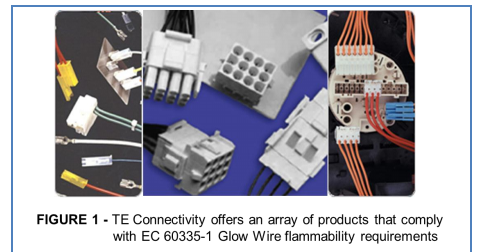
This paper explores glow wire testing, describes the rationale behind the glow wire test procedures and briefly compares the practice to other common flammability test methods. The paper also sheds light on the specifications governing the glow wire testing practice. Finally, it shows BONAD’s commitment toward providing a range of products to help appliance customers meet the glow wire flammability requirements.
What is Glow Wire Testing?
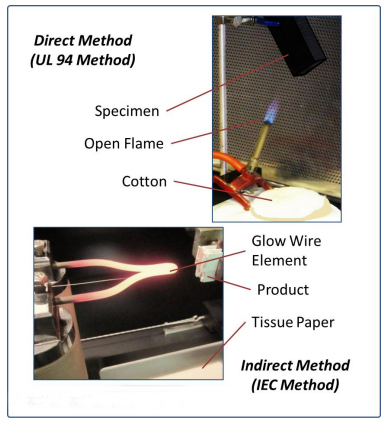
Historically a number of methods have been developed to evaluate material flammability and fire resistance. These include both direct flame and indirect flame testing methods. An example of the direct flame method is defined in the UL 94 specification. This long accepted test method involves applying a flame directly to a vertically or horizontally mounted specimen under controlled conditions. On the other hand, the indirect flame method features a non-flaming heat source applied to a sample. Glow wire testing is an example of the indirect flame method. Test results from applying these methods provide a way to compare the materials’ tendency to resist ignition, self-extinguish flames (should ignition occur), and to not propagate fire via dripping. To better understand the differences between the direct method and the indirect method, refer to Figure 2.
The International Electrical Commission (IEC) established the glow-wire testing method in 2001 because existing test methods did not cover all ignition sources. Specifically, the glow wire test is used to simulate heating effects that may arise in malfunctioning electrical equipment caused by an overloaded connection or component that is overheating.
Glow Wire Test Methodology
Glow wire requirements for home appliances are specified in IEC 60335-1. However, the actual glow wire test methodology is covered in the IEC 60695-2 series of specifications.
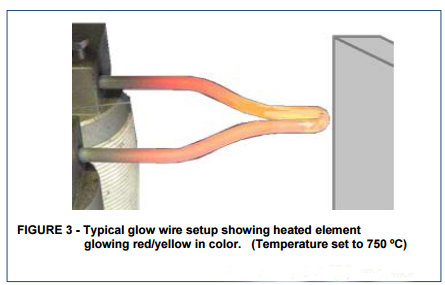
Glow wire testing is performed by heating an element to a pre-determined temperature. The heated element is referred to as the glow wire. See figure 3 for an example of the heated element used for glow wire testing. The sample to be tested is fixture in place and tissue paper is positioned directly below the sample. After reaching the pre-determined temperature, the element is then pressed into a sample material under a set force of 1N for 30 seconds. If ignition occurs, recordings are made to note the duration, flame height, and if drips of the material ignite the tissue paper.
Glow wire testing can be performed on both end products and raw material test plates. The terminology used to define compliance in each case is slightly different.
1. GWT stands for Glow Wire Test (IEC 60695-2-11). GWT is used when glow wire testing is performed on an end product. The results of this test will be either PASS or FAIL at a given temperature. Passing the test requires that the sample does not ignite or self-extinguishes within 30 seconds after removal of the heated element. Also, the sample may not ignite the tissue paper if drips occur.
2. GWFI stands for Glow Wire Flammability Index (IEC 60695-2-12). This is a property associated with raw material used in the end product. This property is determined by conducting the glow wire test on a test plate of a raw material of a given thickness. The Glow Wire Flammability Index (GWFI) is the highest temperature at which the material does not ignite or self-extinguishes within 30 seconds after removal of the heated element.
3. GWIT stands for Glow Wire Ignition Temperature (IEC 60695-2-13). This is a property associated with raw material used in the end product. This property is determined by conducting the glow wire test on a test plate of a raw material of a given thickness. The Glow Wire Ignition Temperature (GWIT) is the lowest temperature at which the material ignites and burns for longer than 5 seconds while the heated element is in contact with the test plate. Knowledge of the three terms is essential to understand how glow wire testing is applied.
4. Knowledge of the three terms is essential to understand how glow wire testing is applied under the overall safety standard IEC 60335-1.
Glow wire testing and IEC 60335-1: Safety of Household and Similar Electrical Appliances
IEC 60335-1 is a general specification that governs the safety of household appliances. Within the specification, glow wire testing is used to evaluate flammability of non-metallic materials supporting current carrying connections used within the appliance.
The glow wire test severity prescribed in IEC 60335-1 is determined by whether the appliance is attended or unattended during use, and by the amount of current that is carried by the connection. Attended appliances are basically any appliance that is operated by an attending consumer such as vacuum cleaners, irons, and coffee pots. Unattended appliances are those that are set in place and operated on their own. Such examples include refrigerators, cooking units, dishwashers, washing machines, and dryers.
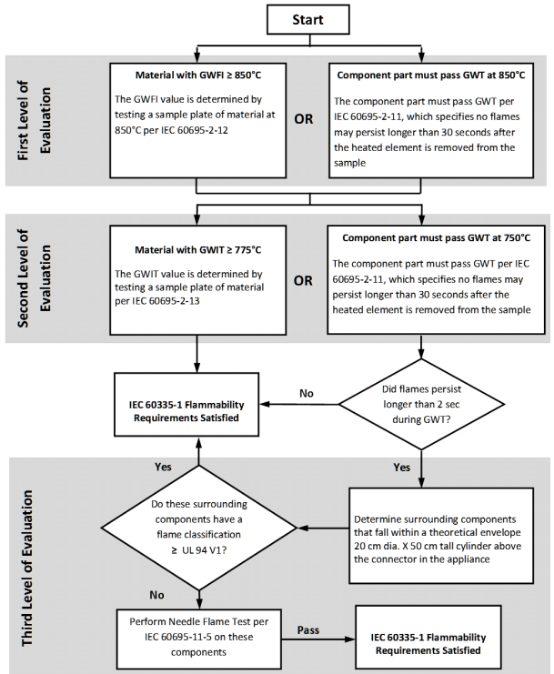
Connectors used in an application that is categorized as unattended with current greater than 0.2A are subject to the most severe evaluation. To comply with this specification, three levels of flammability evaluation may be required:
A:In order to pass the first level of evaluation, the material must have a minimum GWFI 850 oC OR the end product must pass the glow wire test at 850 oC. It is important to note that for the end product to pass, the sample must self-extinguish within 30 seconds as identified in the above passage. The test is subject to the procedure 60695-2-11.
B:· In order to pass the second level of evaluation, the material must have a minimum of GWIT 775 oC OR the end product must pass the glow wire test at 750 oC. It is important to note that if the end product is tested, any ignition must self-extinguish within 2 seconds or the surrounding components must pass a third level of evaluation.
C: The third level of evaluation (performed only if the connector exhibits a flame for longer than 2 seconds) is not performed directly on the connector, but instead is performed on any components within the appliance falling within a theoretical envelope above the connector. Components within the envelope made from a material that has a minimum flammability designation as UL 94 V1 are not subject to further evaluation. However, components within the envelope that have less than UL 94 V1 are subject to a needle flame test.
Refer to the flow diagram located in the Appendix A for an illustration of the testing required for materials supporting connections carrying current greater than 0.2 A in unattended appliances.
Connectors used in Appliances that are categorized as unattended with a current less than 0.2A or categorized as attended appliances are subjected to less severe testing methods. It is important for the appliance manufacturer to understand the appropriate categorization of their finished product, so as to apply the correct level of testing per IEC 60335-1 to the components.
Conclusion
BONAD Connectivity is committed toward providing a range of products to help Appliance customers meet the flammability requirements of IEC 60335-1. TE is continuously evaluating new resins to determine if these materials are suitable for applications where Glow Wire compliance is needed.
Our experience has shown that simply using a resin material that meets the minimum Glow Wire Flammability Index (GWFI) and the Glow Wire Ignition Temperature (GWIT) values for a connector housing will not necessarily produce a final part that will pass the Glow Wire Test (GWT) at 750 oC without flames (≤ 2 seconds). It is important to keep in mind that GWFI and GWIT values are derived from testing performed on test plates, while the GWT is performed on end products. Often times this means the end product will see contact with the heated element for the duration of the test, while the test plates will only see limited contact due to the element burning through the thickness of the plate soon after initial contact. At TE, we work to eliminate any doubt regarding the performance of our products in glow wire tests. Because of this, TE only declares a product to be “Glow Wire Compliant” when the end products have satisfactorily passed TE testing to the most stringent current Glow Wire requirements in IEC 60335-1. Please look to TE Connectivity to answer any questions regarding its commitment to offering the best solutions for your needs.
APPENDIX A
APPENDIX B
Glossary of terms:
Attended – Refers to “Attended Appliance”. Person is present with the appliance during normal operation. Opposite of Unattended.
Current – Electrical Current. Flow of electric charge through an electrical conductor (wire).
End Product – In the context of glow wire testing, it refers to the connector, housing, or insulator product used in conjunction of making a connection.
GWT - Glow Wire Test, performed on end product per IEC 60695-2-11.
GWFI – Glow Wire Flammability Index, property associated with raw material used in the end product. GWFI is the highest temperature at which the material does not ignite or self-extinguishes within 30 seconds after removal of the heated element per IEC 60695-2-12.
GWIT – Glow Wire Ignition Temperature, property associated with raw material used in the end product. GWIT is the lowest temperature at which the material ignites and burns for longer than 5 seconds while the heated element is in contact with the test plate per IEC 60695-2-13. IEC – International Electrotechnical Commission.
IEC is a non-profit, non-governmental international standards organization that prepares and publishes International Standards for all electrical, electronic and related technologies. http://www.iec.ch/
Needle Flame Test - Test used to simulate the effect of small flames. A 12 mm high flame held at a 45° angle is applied to the base of a test specimen for a specified period of time per IEC 60695-11-5.
Short Circuit – Low resistance electrical circuit path that causes current to flow unintentionally.
Test Plate - Raw material molded to be 4” x 4” x specified thickness.
Unattended – Refers to “Unattended Appliance”. Person is NOT present with the appliance during normal operation. Opposite of Attended.
UL – Underwriters Laboratories, Global independent safety science company offering expertise across five key strategic businesses: Product Safety, Environment, Life & Health, Verification Services and Knowledge Services. http://www.ul.com/global/eng/pages/
UL94 – Standard for evaluating flammability using a direct flame method of testing. http://www.ul.com/global/eng/pages/offerings/industries/chemicals/plastics/testing/flame/
VDE – VDE, the Association for Electrical, Electronic & Information Technologies, is one of the largest technical and scientific associations in Europe. http://www.vde.com/en/Pages/Homepage.aspx


